 how-to
How to Personalize Wedding Music Playlists: A Step-by-Step Guide
Table of Contents
- Step 1: Map Your Wedding Music Timeline Before You Pick a Single Song
- Step 2: Build Your Wedding Must-Play and Do-Not-Play Songs
- Step 3: Handle Wedding Guest Song Requests Without Losing Control
- Step 4: Use Wedding Playlist Ideas to Shape Each Moment's Mood
- Step 5: Organize Your Wedding Music Playlists by Moment, Mood, and Energy
- Step 6: Prepare the Technical Setup and Day-Of Contingency Plan
- Common Mistakes to Avoid When Personalizing Wedding Music Playlists
- Frequently Asked Questions
Last Updated: October 21, 2026
Step 1: Map Your Wedding Music Timeline Before You Pick a Single Song
The best wedding music playlists start with a timeline, not a song list. A wedding day is a series of music moments, and each one needs its own mood, energy level, and song count. At LOVE, HAPPINESS & FAMILY LLC, we have spent over 15 years watching couples build soundtracks from the ground up, and the ones that flow best always begin here.
Map your day into these blocks before you touch a single track:
- Prelude: 20-30 minutes of background music as guests arrive
- Ceremony: processional, entrance song, and recessional
- Cocktail hour: light, upbeat background music
- Dinner: low-volume dinner music that lets people talk
- Dancing: warmup music, peak-energy set list, and last dance
Write the start and end time for each block. Then note who is walking, speaking, or dancing in each one.
That single page becomes your planning backbone. Every song you pick later gets slotted into a block, which stops the chaos of a 200-song list with no order.
Step 2: Build Your Wedding Must-Play and Do-Not-Play Songs
Your wedding must-play and do-not-play songs lists are the fastest way to make a playlist feel personal. Start with three columns: must-play, nice-to-have, and do-not-play.
Here is how we would build it:
- Each partner writes 10 songs that mean something to them.
- Merge the lists and cut duplicates.
- Add a do-not-play list for songs tied to bad memories or overplayed tracks you cannot stand.
- Mark the three or four songs that absolutely must play at peak dance time.
A common mistake is listing 100 must-plays. That is a set list, not a preference. Ten to fifteen per partner is plenty, and it leaves room for the crowd.
Step 3: Handle Wedding Guest Song Requests Without Losing Control
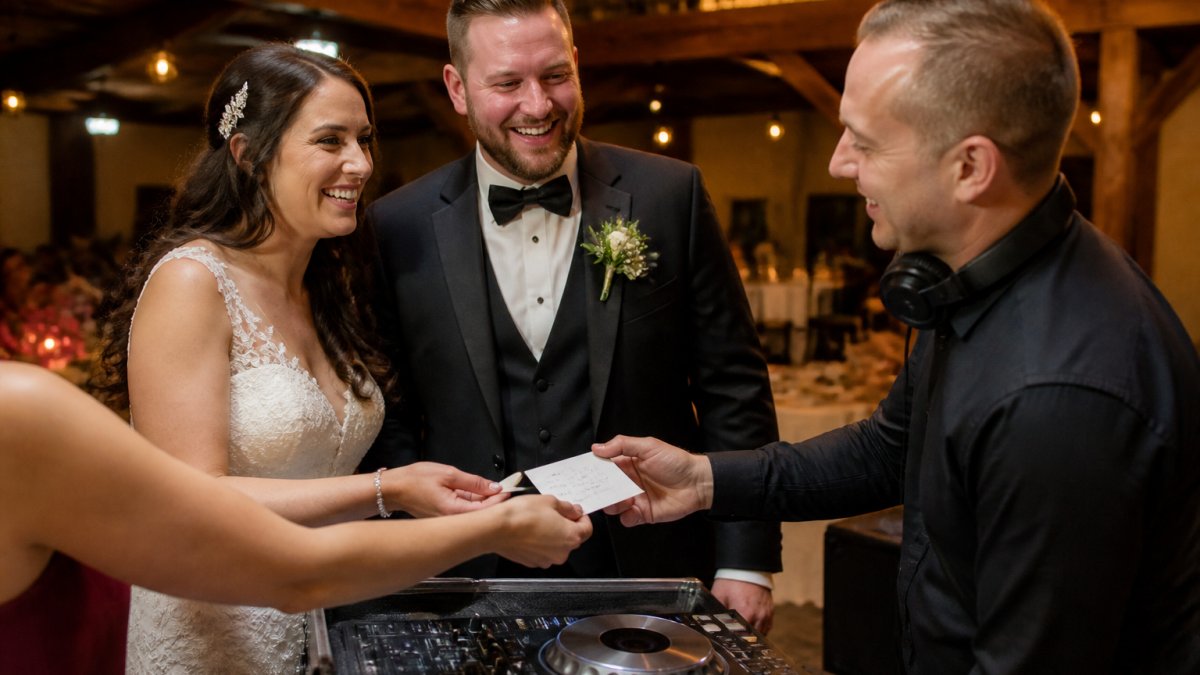
Wedding guest song requests can make or break a dance floor, so set a policy early and build a screening system, not just an inbox. Most couples who take requests without a filter end up with a DJ cornered by guests and a set list that drifts.
Start with the policy itself. Decide on three things before you publish anything:
- Whether you accept requests at all. "No requests, please, we have a full set planned" is a complete and acceptable policy.
- How guests submit them. A line on the RSVP card, a wedding website form, or a shared spreadsheet all work; a verbal free-for-all does not.
- When the window closes. Close submissions two to three weeks before the wedding so you have time to review and hand a clean list to your DJ.
A workable submission line: "Have a song that will get you dancing? Send us one suggestion by [date] and we will consider it for the reception." Cap each guest at one or two songs so the list stays reviewable.
Then screen. Build a review sheet with four columns: song, guest, decision, and reason. Run every suggestion through these filters:
- Do-not-play conflict. Any song on your do-not-play list is an automatic no, no discussion needed.
- Moment fit. A slow ballad suggested for the dancing block may work at dinner instead. Reassign rather than reject when you can.
- Duplicate and near-duplicate. Multiple guests will suggest the same track. Keep one entry and note the overlap, a song requested by five guests is a strong signal for peak dance time.
- Tone and content. Screen for explicit lyrics, inside jokes that will not land with the room, and songs tied to a family sensitivity. Decide in advance whether you want a clean version.
- Crowd fit. A request that only one guest will dance to is a low priority; a song that pulls three generations onto the floor is a keeper.
Sort the approved songs into two buckets: a request pool the DJ can draw from when the floor needs a lift, and a scheduled set of requests you want played at a specific moment. Hand the DJ both, clearly labeled.
Handle the awkward cases in advance so you are not deciding mid-reception:
- Conflicting tastes. If one side of the family wants classic rock and the other wants Top 40, schedule one block for each rather than letting the DJ alternate all night.
- The guest who keeps asking. Give the DJ a script: "The couple has a set list, but I will pass that along." The DJ absorbs the pressure so you do not have to.
- The request that bombs. Give the DJ explicit permission to cut any song after 30 to 45 seconds if the floor empties. A request that flops is not a failure; leaving it on is.
Step 4: Use Wedding Playlist Ideas to Shape Each Moment's Mood
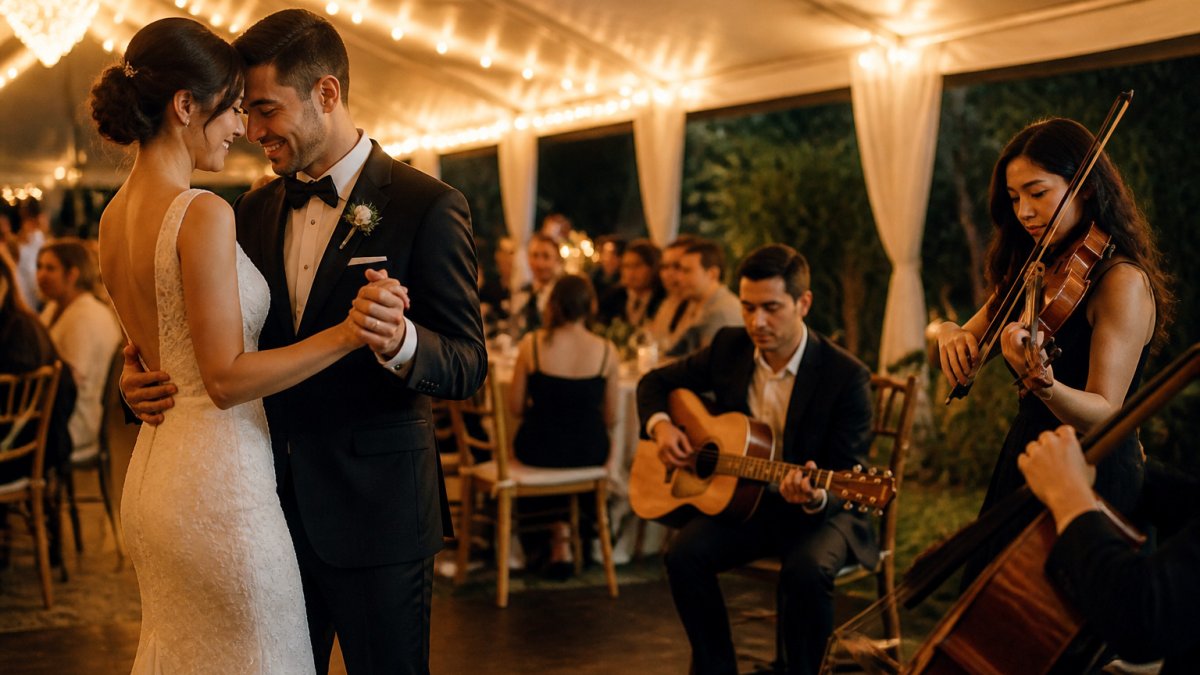
Wedding playlist ideas work best when you match genre and tempo to the moment, not just to your taste. A song that crushes it at 10 p.m. can flatten a dinner hour.
Try this mapping:
- Prelude: soft acoustic, light jazz, or instrumental covers
- Processional and entrance: one bold, meaningful song per person or group
- Cocktail hour: upbeat soul, pop, or light funk at low volume
- Dinner: mellow classics and easy listening
- Dancing: warmup tracks first, then your peak-energy must-plays
Your favorite genres and artists should guide the whole thing. If you both love country, lean into it. If your tastes split between hip-hop and indie, use one for cocktail hour and the other for dancing.
The goal is a music flow that feels like you, moment by moment.
Step 5: Organize Your Wedding Music Playlists by Moment, Mood, and Energy
Organizing by moment beats one giant list every time. Build a separate playlist for each block, then tag each song with a mood and an energy level.
Use a simple scale:
| Playlist | Mood | Energy (1-5) | Song Count |
|---|---|---|---|
| Prelude | Calm, welcoming | 1-2 | 8-10 |
| Ceremony | Emotional, focused | 2-3 | 3-4 |
| Cocktail hour | Light, social | 3 | 15-20 |
| Dinner | Relaxed | 2 | 15-20 |
| Dancing | High, celebratory | 4-5 | 30-40 |
This playlist organization does two things. It gives your DJ a clear map, and it lets you swap a song without breaking the whole night.
Song order matters inside each list. Open the dancing block with familiar mid-tempo tracks, then climb. Save your biggest must-plays for the middle of the set, and close with a last dance you both love.
Step 6: Prepare the Technical Setup and Day-Of Contingency Plan
Technical setup and a backup plan keep the music running when something goes wrong, and the couples who stress least are the ones who planned for the boring details.
Start with song-count math. A typical song runs about three to four minutes. Use that to size each block and build in a buffer:
| Block | Typical length | Songs needed (at ~3.5 min) | Buffer to add |
|---|---|---|---|
| Prelude | 20-30 min | 6-9 | 3-4 extra |
| Ceremony | 10-15 min | 3-4 | 1-2 extra |
| Cocktail hour | 60 min | 15-18 | 4-5 extra |
| Dinner | 60-75 min | 15-20 | 5 extra |
| Dancing | 2-3 hours | 30-45 | 8-10 extra |
Overbuild every block by roughly 20 percent.
Build the technical handoff. Your DJ or band needs more than a link. Prepare a single folder or shared document that contains:
- The timeline with start and end times for each block
- Each playlist labeled by moment, with mood and energy tags
- The must-play list and the do-not-play list, both in writing
- The approved request pool, clearly separated from the scheduled set
- A backup copy of every playlist on a phone and a USB drive
Ask your DJ these questions before the wedding: Do you carry backup gear and a backup power source? Can you play from a phone if the laptop fails?
Plan for the day-of variables. Build a short contingency sheet:
- Timing slips. Mark which songs can be trimmed or skipped if the schedule runs late, and which must-plays are non-negotiable.
- Venue or weather change. Have a second ceremony playlist ready in case the event moves indoors or the order of events shifts.
- Equipment failure. Confirm the DJ's backup plan in writing, and know where the venue's sound system ties in.
- A song that clears the floor. Give the DJ permission to cut it and move on within 30 to 45 seconds.
Read the room in real time. The playlist is a plan, not a script. Watch the dance floor during the first three or four dancing songs.
Flag accessibility and family needs. Note any cultural or religious music that must be included, any multilingual songs for family members, and any volume concerns for older guests or a venue with a sound limit.
Common Mistakes to Avoid When Personalizing Wedding Music Playlists
The biggest mistake is treating your wedding music playlists as a static list instead of a living plan. Here is what we see go wrong most often:
- No timeline: songs with nowhere to go create dead air and awkward transitions.
- Too many must-plays: a bloated list leaves no room to read the crowd.
- Ignoring the guests: a playlist built only for the couple can empty the dance floor.
- No do-not-play list: one wrong song can kill the mood in seconds.
- Skipping the tech check: playlists that only exist on one phone are a risk.
- Forgetting song transitions: abrupt cuts between genres break the flow.
The fix for all six is the same: plan by moment, tag by mood, and hand your DJ a clear set of cues.
Frequently Asked Questions
What order do wedding songs go in?
Follow the flow of the day: prelude music as guests arrive, processional for the entrance, a short recessional, then cocktail hour, dinner music, and open dancing. Within the dance floor block, start with mid-tempo songs everyone knows, build to high-energy peaks, and slow down briefly before the last dance. Your wedding music timeline should list a start time for each block so your DJ knows exactly when to shift energy, and leave room for 10 to 15 minutes of flexibility around toasts and dinner service.
How many songs do you need for a wedding playlist?
Plan for roughly 60 to 80 songs across the full day. Cocktail hour needs about 15 to 20 background tracks, dinner music another 15 to 20, and a three-hour dance floor block runs about 40 to 45 songs at three to four minutes each. Build in a buffer of 10 extra songs per block so your DJ can adjust if a section runs long or the crowd responds to a different direction than expected. Fewer songs, well-sequenced, beat a bloated list every time.
How can you include guest song requests without losing your wedding's style?
Set up a request line before the wedding, either on your RSVP form or a shared playlist link, and screen submissions against your do-not-play list. At the reception, give your DJ authority to accept requests that fit the current mood and politely defer the rest. A practical rule: guests can request songs, but the couple and DJ decide placement. This keeps wedding guest song requests from hijacking the dance floor while still making friends and family feel heard.
What songs should you put on a wedding do-not-play list?
Include anything tied to a past relationship, songs with lyrics that clash with a family-friendly crowd, group dances you actively dislike, and tracks that reliably clear your particular dance floor. Also list any artist a parent or close family member has asked you to avoid. Keep the do-not-play list short and specific, maybe 10 to 15 songs, and hand it to your DJ in writing. Clear boundaries protect the mood and prevent awkward moments you cannot undo once the song starts.
Personalizing wedding music takes real planning, and the details are where celebrations shine or stall. LOVE, HAPPINESS & FAMILY LLC builds that plan with you, from timeline mapping to crowd-reading DJs who keep the energy moving. Our team brings over 15 years of experience, custom lighting and monogram projections to set the atmosphere, and immersive photo booth experiences that give guests something to do between dances. Contact us to craft a soundtrack that feels like you, start to finish.