 ultimate-guide
Wedding DJ Backup Plans and Reliability: 2026 Guide
Table of Contents
- Why Wedding DJ Reliability Is a Technical Problem, Not Just a Personality Trait
- What a Professional Wedding DJ Backup Plan Actually Includes
- Questions to Ask a Wedding DJ About Equipment Before You Sign
- Wedding DJ Contract Contingency Clauses You Need in Writing
- Professional DJ Backup Equipment List: What Should Be in the Truck
- Outdoor and Destination Weddings: Backup Protocols Most DJs Skip
- The Plan B DJ Network, Insurance, and Liability in Backup Scenarios
- Frequently Asked Questions
Last Updated: September 27, 2026
Why Wedding DJ Reliability Is a Technical Problem, Not Just a Personality Trait
A wedding DJ backup plan is the documented set of redundant equipment, playback systems, personnel, and contractual guarantees that keep music playing when something fails. At LOVE, HAPPINESS & FAMILY LLC, we treat reliability as an engineering problem, not a personality trait. A charming DJ with one laptop and no spare cables is a single point of failure wearing a nice suit.
What a Professional Wedding DJ Backup Plan Actually Includes
A professional backup plan covers four failure categories: power, playback, sound, and personnel. If a DJ can't name their solution for all four, the plan doesn't exist.
Redundancy in Sound Systems: The Two-Is-One Rule
The two-is-one rule means nothing critical runs as a single unit. Two laptops, two mixers, two wireless microphone receivers, and two sets of cables for every connection.
Backup Playback Devices and Software Stability
Software crashes are the quiet killer of receptions. A DJ running one laptop with no offline library is one update or corrupted file away from silence.
Questions to Ask a Wedding DJ About Equipment Before You Sign
Ask these before signing anything, and demand specific answers, not reassurances.
- What happens if your laptop dies mid-reception?
- Do you carry a backup mixer, and is it connected and powered on during the event?
- How many wireless microphones do you bring, and do you have a wired backup?
- What's your plan if the venue's power supply fails?
- Can you show me your backup equipment list in writing?
Wedding DJ Contract Contingency Clauses You Need in Writing
Contingency clauses are the contractual side of wedding DJ backup planning. Without them, you have no recourse if equipment fails or the DJ cancels.
Professional DJ Backup Equipment List: What Should Be in the Truck
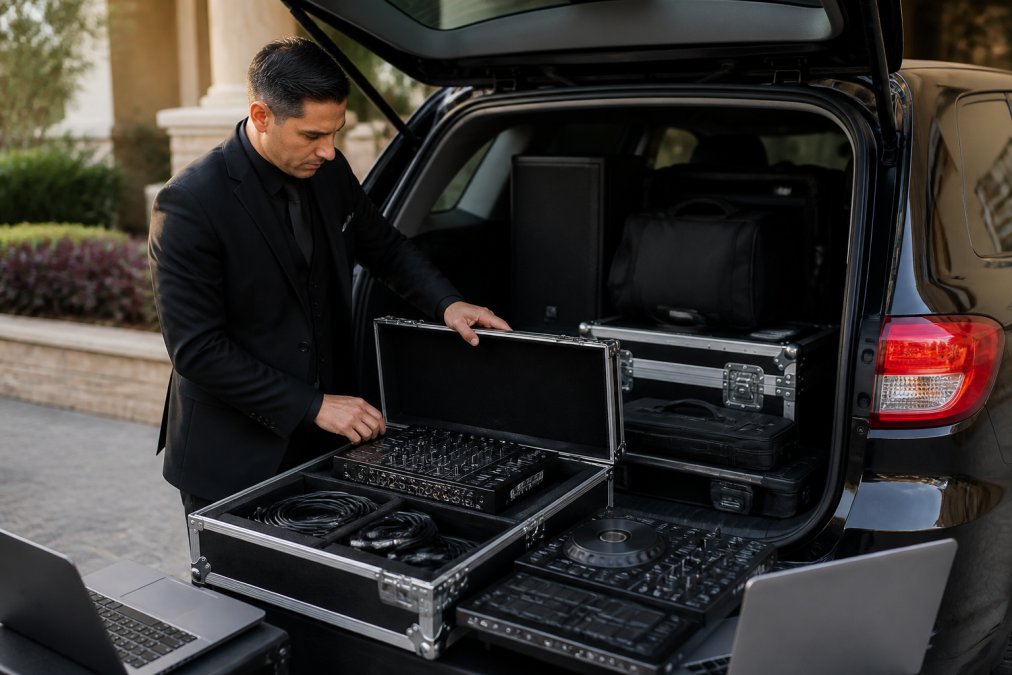
A professional DJ backup equipment list covers power, playback, sound, and lighting, but a list alone isn't a plan. What separates a real kit from a wish list is the signal chain: every link between the music file and the speaker cone needs a tested alternate path. Below is the gear by chain position, plus the failure mode each item defeats.
Playback Layer
- Second laptop or tablet, fully charged, running the same software version as the primary, with the full library loaded locally, not streamed. Streaming fails when venue Wi-Fi congests the moment guests arrive.
- External SSD or hard drive with a duplicate library, plus a cloud copy as a third tier. The on-site drive matters during the event; the cloud copy covers catastrophic loss.
- Offline mode enabled on both devices, with automatic updates disabled at least 48 hours before the event. A mid-reception OS update is a self-inflicted outage.
Mixing and Control Layer
- Backup mixer or controller, powered on and connected to the same amplifier or powered speakers as the primary. A spare in a bag is inventory, not a backup, the two-is-one rule only works if the swap takes seconds.
- Spare audio interface if the primary rig uses one, since USB interfaces fail more often than mixers themselves.
- Cue sheet or setlist printed on paper. Software can fail; paper cannot.
Signal and Cable Layer
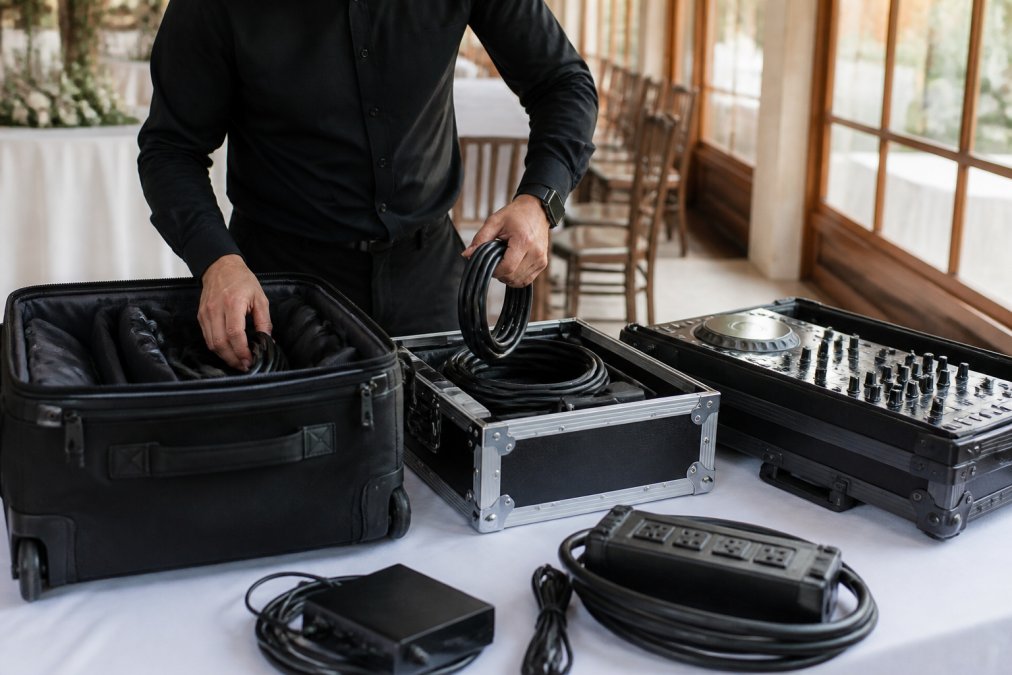
- Spare XLR cables (at least two per microphone run), spare 1/4-inch and RCA cables, spare USB cables, and spare power cables for every powered device. Cables are the most common failure point in any mobile rig because they flex, get stepped on, and corrode at the connector.
- Spare power strips and a surge protector rated for the venue's circuit. A single tripped breaker should never end the reception.
- Cable tester, a small, inexpensive tool that catches a bad cable before it becomes dead air.
Microphone Layer
- Wired microphone as the non-negotiable backup for every wireless channel. Wireless dropouts spike when a venue fills with guests whose phones compete for the same RF spectrum.
- Spare wireless receiver and transmitter batteries (fresh, not 'still good from last week').
Power Layer
- Battery backup or inverter sized to run the mixer, one laptop, and one mic receiver for at least 30 minutes. Unlike a generator, it bridges a breaker trip or brief outage while venue power is restored.
- Generator for outdoor venues without reliable grid power, sized to the rig's actual draw, not the label wattage.
Lighting Layer
- Backup lighting controller and at least one spare fixture, since a single failed uplight or moving head can leave a focal point dark during the first dance.
The Backup Gear Checklist
Use this as an audit tool. Ask your DJ to walk through it line by line, and ask which items are connected and powered on during the event versus packed as spares.
- Second laptop or playback device, fully charged, preloaded, offline mode on
- External SSD or hard drive with duplicate library, plus cloud copy
- Backup mixer or controller, connected and powered on
- Spare audio interface and cables (XLR, 1/4-inch, RCA, USB, power)
- Cable tester
- Wired microphone as backup for every wireless channel
- Fresh batteries for wireless transmitters and receivers
- Battery backup or inverter sized for 30+ minutes of core rig
- Generator (outdoor venues without reliable power)
- Surge protector and spare power strips
- Backup lighting controller and spare fixture
- Printed setlist and cue sheet
| Failure Point | Backup Solution | Why It Matters |
|---|---|---|
| Laptop crash | Second laptop, preloaded, offline | Keeps music playing in seconds |
| Software update mid-event | Updates disabled 48 hours prior | Prevents self-inflicted outage |
| Mixer failure | Backup controller, powered on | Avoids dead air mid-song |
| Cable failure | Spare XLR, power, USB cables | Most common failure point |
| Wireless mic dropout | Wired microphone backup | Protects toasts and vows |
| Breaker trip | Battery backup or inverter | Bridges the gap until power returns |
| Streaming outage | Local library on both devices | Removes Wi-Fi as a dependency |
| Lighting failure | Spare controller and fixture | Keeps focal moments lit |
Outdoor and Destination Weddings: Backup Protocols Most DJs Skip
Outdoor and destination weddings demand stricter backup protocols because the environment is a variable: heat, wind, uneven power, and distance from the DJ's home base all raise failure risk.
The Plan B DJ Network, Insurance, and Liability in Backup Scenarios
The Plan B DJ network is a group of professional DJs who agree to cover each other's events in an emergency. It's the difference between a real backup plan and hoping nothing goes wrong, but most couples never learn how the network functions, so it stays a vague promise instead of a verifiable safety net.
How a Real Plan B Network Works
A functioning network has four moving parts:
- A named roster. The DJ belongs to a local or regional group, a professional association, multi-op company, or circle of established operators, whose members agreed in advance to cover each other's dates.
- A shared calendar or on-call rotation. When a DJ gets sick or a rig fails, the network knows who is free that night. This is why the network only works if it's local: a DJ three states away cannot save a reception at 6 p.m.
- A gear-compatibility standard. Network members typically run similar software and connector standards so a substitute can plug into the existing setup without a rebuild.
- A written trigger. The contract should state the specific conditions under which the network is activated, illness, vehicle failure, equipment loss, and who contacts whom.
Ask your DJ three questions: Which network do you belong to? How many members are within 30 miles of my venue? And can I see the names of two who have covered for you in the past three years? A DJ who can't answer all three is describing a favor, not a network.
Insurance and Liability: What Actually Covers What
Liability insurance and backup planning intersect in three places couples often conflate:
- General liability insurance covers third-party injury and property damage, a guest tripping over a cable, a speaker falling on venue property. Most venues require a certificate of insurance (COI) naming the venue as additionally insured before the DJ loads in.
- Equipment coverage (often a rider or a separate inland marine policy) covers the DJ's own gear against theft, damage, or failure. This funds a fast replacement, but it does not reimburse the couple for a ruined reception.
- Errors and omissions or professional liability covers claims that the DJ's failure to perform caused the couple financial loss. This is the coverage that matters most when a DJ no-shows or a rig fails and there's no backup.
The Contract Clause That Ties It Together
Your contract should name the specific backup DJ or network, state the activation trigger, and specify the remedy if neither the primary DJ nor the network performs, typically a full refund plus a defined credit. A clause that promises to 'find someone' is not a clause; it's a sentence.
Frequently Asked Questions
What should be included in a professional wedding DJ backup plan?
A complete wedding DJ backup plan covers three layers: gear, people, and process. On the gear side, that means a second laptop or playback device, a spare mixer, backup wireless microphone, extra cables and connectors, and a power supply option that does not rely on a single outlet. On the people side, it means a named substitute DJ who already knows your event timeline. On the process side, it means a written contingency plan for technical failures during the event, including who handles troubleshooting and how the event flow continues without dead air.
Do professional DJs carry backup equipment for weddings?
Reliable ones do, but you should verify it rather than assume it. Ask specifically what happens if the primary mixer fails mid-reception, whether a second playback device stays powered on and ready, and how they handle a hard drive failure if their music library is stored locally. Many DJs also keep a cloud backup of the playlist and event timeline. A DJ who hesitates on these questions is telling you something. Get the answer in writing as part of your wedding DJ contract contingency clauses.
What happens if my wedding DJ gets sick on the day of the event?
This is exactly why the Plan B DJ network matters. A professional DJ should be able to name a specific colleague who can cover the event, not promise vaguely that they will figure something out. Ask for the substitute's name and confirm they have access to your event timeline, music library, and venue requirements. The best contracts spell out that a replacement of comparable experience will be provided, and that you will be notified immediately if the substitution is triggered.
How do I verify the reliability of a wedding DJ before booking?
Start with their professional track record: ask how many weddings they have played in the past year and request references from events similar to yours. Then move to the technical side. Ask what redundancy exists in their sound system, how they handle signal interference on wireless microphones, and whether they carry liability insurance. Finally, read the contract for emergency replacement language. A DJ who welcomes these questions and answers them with specifics is far more reliable than one who deflects them.